Newt Berringer
The TommyknockersNewt Berringer is a Haven resident drawn into the town’s tightening collective will as its inhabitants change under the influence of the buried ship. His role is most sharply defined when that will becomes a weapon: alongside Dick Allison and other members of the Shed People, Newt helps turn fear of Jim Gardener into a town-wide command to stop him from reaching or damaging the ship.
Identity and Place in Haven
The available scenes identify Newt through his place in Haven’s increasingly coordinated community, rather than through a separate personal history. He is closely associated with Dick Allison: the two spend time together, share information, and act in concert as the town’s crisis grows. That connection matters because their cooperation is not simply private friendship or convenience. Dick and Newt participate in decisions about keeping Haven closed to outsiders, and later they are among those whose minds contribute to a command that mobilizes the town against Gardener.
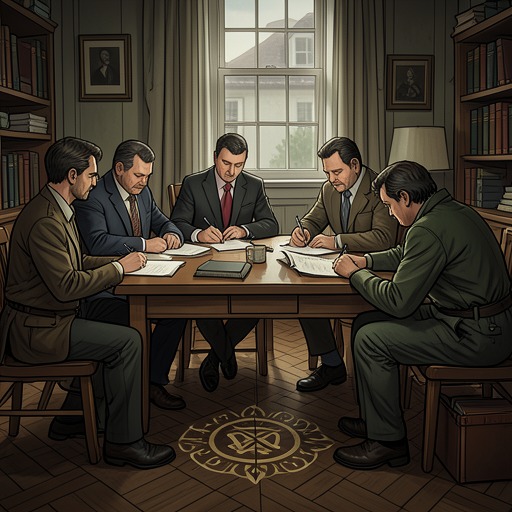
Newt’s position also links the ordinary routines of the town to its extraordinary change. He plays cribbage with Dick while they wait for a telephone call, an everyday diversion that has become absurdly transparent because each man already knows the other’s cards. Yet the game takes place within an altered social order: the two are waiting to hear that Gardener is dead, after which the next phase of the work can begin. The cards, the telephone, and the expected report all belong to a familiar domestic world, but their purpose has been recast by the town’s transformation.
The Closing of Haven
Newt is involved in the decision not to place force fields across most of the roads into Haven. The town’s batteries are nearing a critical state again, but the immediate concern is concealment: Dick and Newt do not want an outsider to encounter an invisible barrier, turn back, and carry news of the town to the outside world. Their choice allows John Leandro to cross the town line without difficulty. It is therefore a calculated compromise. Haven is meant to be closed, but the residents avoid a conspicuous obstruction that could expose the closure to people beyond it.
Dick and Newt’s conversation reveals the limits of that strategy. Dick recalls that he once believed no one could come so close to Haven, but his confidence has been shaken by Ev Hillman and Bobbi Anderson’s sister. The men conclude that someone might get in, but would never get out again. That expectation of containment sits uneasily beside their decision to leave the road apparently open. The town’s perimeter is not simply a line of defenses: it is managed through secrecy, selective access, and the belief that anyone admitted can be prevented from leaving.
Dick Allison and the Waiting Game
Newt and Dick’s companionship is shown in a brief, revealing scene at Newt’s house. They are playing cribbage while waiting for the telephone to ring and for Bobbi to tell them that Gardener has died. The game is described as pointless because each knows what the other holds; Newt has no Parcheesi board, and the two are merely passing time. Beneath this idle surface lies a shared anticipation of violence. They expect Gardener’s death to clear the way for the next stage of their work, and the call is imagined as confirmation that the obstacle has been removed.
The waiting ends not with the expected news but with an emergency. When Bobbi’s screams break into the inhabitants’ minds, Newt and Dick are still together at the cribbage table. Newt sprays cards across the table and floor as the crisis strikes. Dick bolts for the door but runs into the wall beside it, an abrupt physical failure that punctures the pair’s apparent control. Their earlier confidence in decisions about roads, outsiders, and the town’s future gives way to confusion and alarm.
The Shed People’s Command
After Bobbi’s screams, the mental voices of Dick, Kyle Archinbourg, Adley, and Newt gather into what the narration calls the Command Voice. Newt’s voice becomes part of a collective message: Gardener must be stopped before he can do anything else, and, more specifically, before he can do anything to the ship. The command spreads with the force of an order that the residents do not think to refuse. Newt is not merely present among the people responding to the emergency; his mental voice helps constitute the authority that directs them.
The scene makes the group’s unity both powerful and unsettling. A crowd of individuals becomes a single voice, repeated until the words form a hammering litany. The command has a concrete destination and purpose: Haven’s residents set out for Bobbi’s farm, four miles away, while the urgency of the message grows. Among them are people preparing to use dangerous devices against Gardener. The collective voice thus converts a shared fear into coordinated pursuit, collapsing personal judgment into the imperative to protect the ship from him.
Newt’s contribution is part of a larger transformation in which the town’s methods of communication and control have become inseparable from its altered inhabitants. The residents do not need to persuade one another through ordinary speech; their thoughts join, and the command becomes difficult to deny. Newt’s movement from the private cribbage game to this unified mental order captures the reversal at the center of his role: the man waiting for a report becomes one of the voices driving Haven into action. The available evidence leaves his individual fate unresolved, but establishes him as a participant in the town’s collective attempt to stop Gardener and defend the ship.